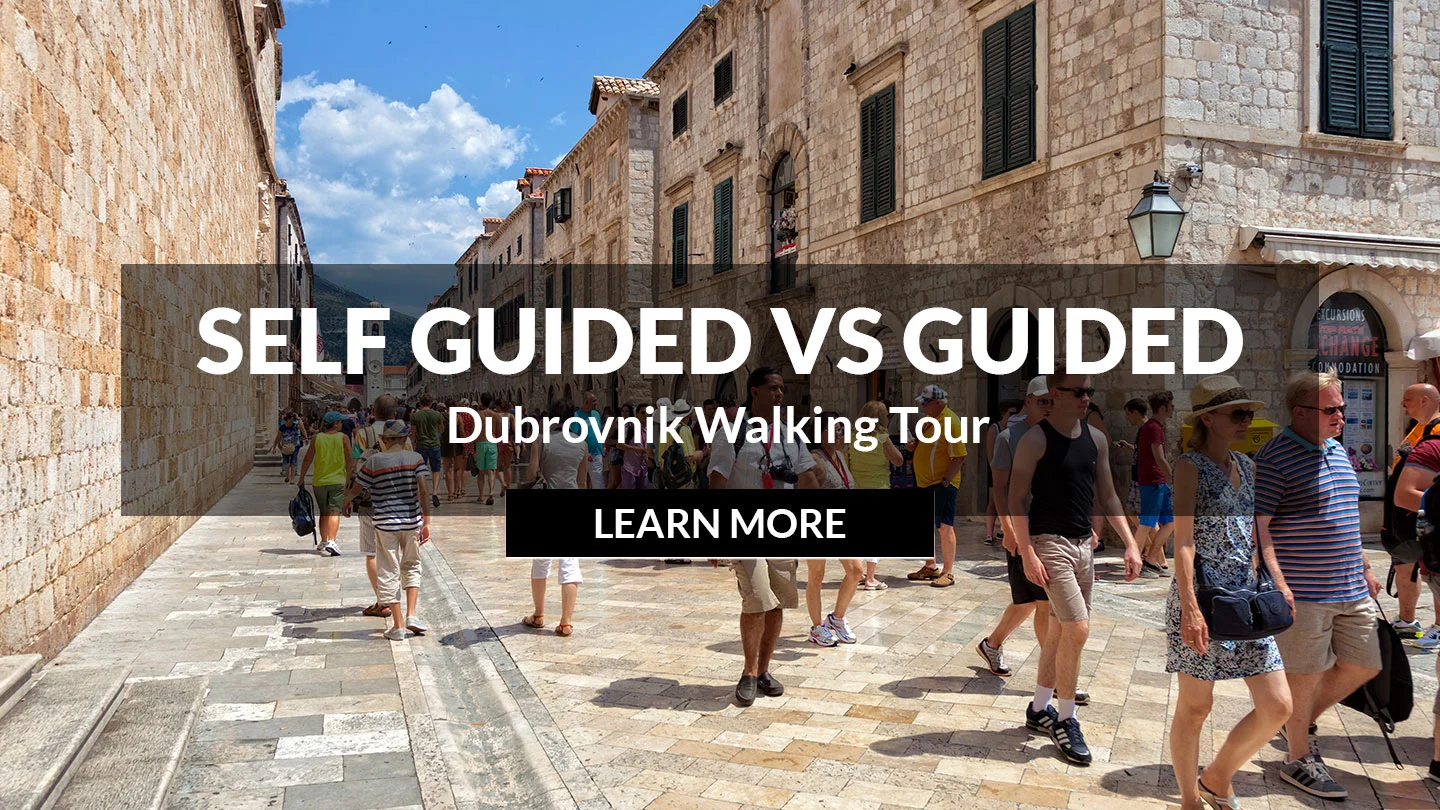
A self-guided walk through Dubrovnik gives you freedom to explore Stradun and the Old Town at your own pace. A guided walking tour gives you the history and context behind what you’re looking at, the same streets, but understood rather than just seen. Which one is better depends on what you’re actually looking for from your visit.
Dubrovnik’s Old Town is compact, fully pedestrian, and easy to navigate, which is exactly why the question comes up. Unlike cities where getting lost is part of the risk, here the real question isn’t can you explore alone, it’s what you’ll miss if you do.
What a Self-Guided Walk in Dubrovnik Feels Like
Most self-guided walks begin at Pile Gate, stepping directly onto Stradun, the main limestone street running through the heart of the Old Town. The symmetry of the street, the polished stone underfoot, and the buildings on either side create an immediate sense of atmosphere.
From there, you’re free to wander into side alleys, small squares, and churches with no fixed route or timing. For many travelers, that’s enough, photographs, cafés, atmosphere, no schedule to follow.
But a pattern tends to show up partway through: everything starts to look meaningful, without actually feeling understood. You pass ancient buildings without knowing their purpose. Even the City Walls, impressive as they are, can start to feel visually striking but historically silent.
Quick answer: Self-guided walking in Dubrovnik works well for flexibility and casual sightseeing, but it doesn’t explain the historical or cultural meaning behind what you’re seeing.
What Changes With a Guided Walking Tour
A guided walking tour turns Dubrovnik from a beautiful backdrop into a story you’re walking through. Stradun stops being just a main street — it becomes the central spine of a fortified medieval trade city, deliberately designed for movement and commerce during the Republic of Dubrovnik. The narrow side streets aren’t random anymore; they’re part of a structured layout that supported daily life inside the walls.
A local guide connects details a map or guidebook can’t — which corner mattered, why a building sits where it does, what the city actually looked like when it was functioning as an independent maritime republic.
The City Walls: Where the Difference Is Clearest
This is where the gap between the two experiences is most obvious. Walking the City Walls on your own is still one of the most visually striking things you can do in Europe — red rooftops, the Old Town below, the Adriatic in the distance. But it’s mostly visual.
With a guide, that same view becomes strategy and survival: why the walls were built the way they were, how they protected the Republic for centuries, and how they fit into a larger defensive system that let Dubrovnik hold its independence in a genuinely difficult political neighborhood.
Quick answer: The Dubrovnik City Walls aren’t just a viewpoint – they’re a historically engineered defense system that shaped how the city survived and developed for hundreds of years.
Self-Guided vs Guided Dubrovnik Walking Tour: Quick Comparison
| Self-Guided Walk | Guided Walking Tour | |
|---|---|---|
| Flexibility | Full — go anywhere, anytime | Fixed route and schedule |
| Cost | Free (beyond entry fees) | Paid, per group or person |
| Historical context | Minimal — self-researched | Explained in real time by a local guide |
| Best for | Repeat visitors, casual sightseeing, photography | First-time visitors, anyone wanting real context |
| City Walls experience | Visually impressive, no context | Understood as a defensive system, not just a view |
| Pace | Entirely your own | Set by the group and guide |
Who Self-Guided Walking Is Actually Good For
Self-guided exploration isn’t a lesser option — it’s the right fit for specific travelers: people who prefer independence, enjoy spontaneous discovery, or are returning to Dubrovnik and already know its history. It also works well if your main goal is photography, relaxation, or casual sightseeing rather than deep historical context. The Old Town’s layout naturally guides you through its key areas without instructions.
Who Benefits Most From a Guided Walking Tour
A guided walking tour is the better fit for first-time visitors, or anyone who wants to actually understand what they’re looking at rather than just photograph it. Instead of guessing at a building’s purpose, you learn it. Instead of isolated landmarks, you get one continuous story — how Dubrovnik functioned as a maritime republic, how its architecture reflects that history, and how daily life operated inside the walls centuries ago. If that sounds like your trip, it’s worth browsing the full range of Dubrovnik walking tours before deciding which one fits.
Experience Dubrovnik with a local guide
This is exactly what the Private Walking Tour in Dubrovnik with Local Guide is built for: a 120-minute route from Stradun to the City Walls that connects the Old Town’s most important areas into one continuous story instead of a list of stops.
Frequently Asked Questions
Yes – it’s compact, fully pedestrian, and easy to navigate without a guide. The challenge isn’t finding your way, it’s understanding the history behind what you’re seeing.
Most guided walking tours run around 2 hours, covering Stradun, the Old Town’s side streets, and the City Walls.
For first-time visitors, yes — a guide connects landmarks into a single story instead of a checklist of sights, which is hard to replicate through self-guided walking alone.
Yes, and many visitors do exactly this: a guided tour early in the trip for context, followed by self-guided time to revisit places at their own pace.